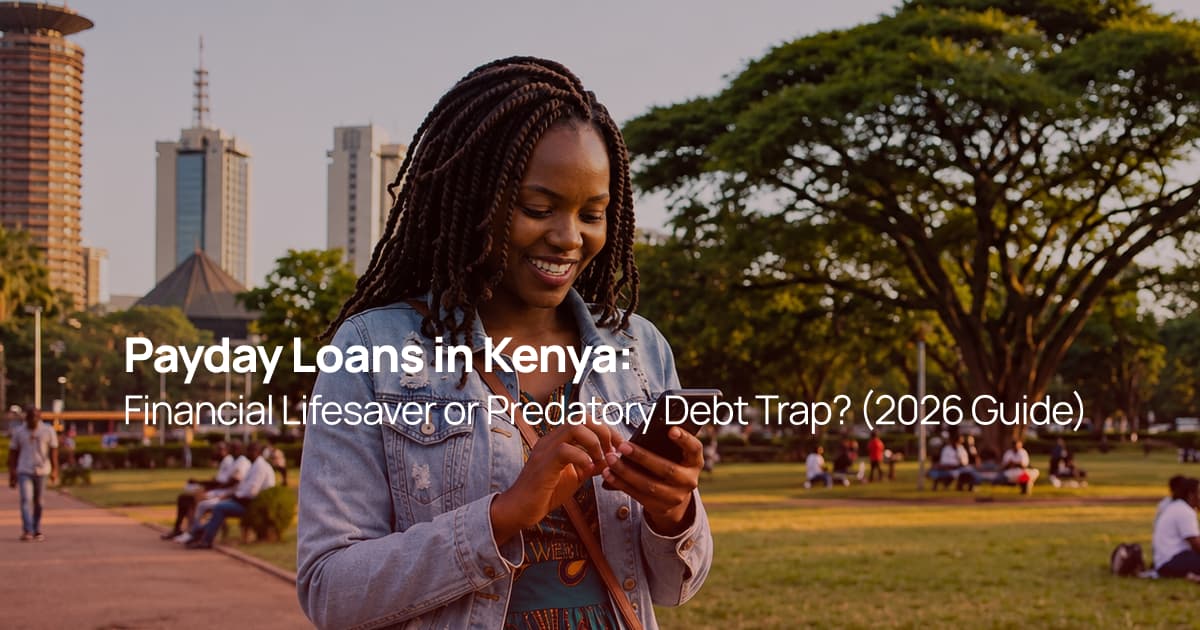
Payday Loans in Kenya: Financial Lifesaver or Predatory Debt Trap? (2026 Guide)
Advertiser Disclosure: MoneyHello is an independent, advertising-supported comparison service. We may earn a referral fee if you click our links or use our matching tool to connect with a lender. This does not affect the content of our articles or the loan offers you receive.
Are payday and digital mobile loans in Kenya a lifesaver in emergencies or a dangerous debt trap? Explore true borrowing costs, CBK regulations, APR calculations, and safer financial alternatives.
When an unexpected emergency strikes mid-month, whether an urgent medical bill, sudden car repairs, or depleted electricity tokens, the pressure to find immediate cash can feel overwhelming. In Kenya, mobile phones make borrowing money simpler than ever. With just a few taps on an app or a USSD code, credit appears in your M-Pesa account within minutes.
For many salaried and wage-earning Kenyans, a payday loan or short-term mobile credit advance feels like an immediate financial lifesaver. It bridges the liquidity gap when cash runs dry before the next salary arrives.
However, convenient digital borrowing often comes with significant trade-offs. High short-term facilities, rapid repayment cycles, and compounding rollover penalties can transform a temporary stopgap into a severe debt cycle. Understanding how these short-term credit products work, the true annualised cost of borrowing, and the legal protections established by the Central Bank of Kenya (CBK) is critical before taking on digital debt.
What Is a Payday Loan in the Kenyan Market?
Traditionally, a payday loan is a short-term, high-cost unsecured loan designed to be repaid in a single bullet payment on the borrower’s upcoming payday. In Kenya, the product has evolved primarily into digital micro-loans and mobile salary advances disbursed via mobile money networks like M-Pesa.
These products are offered through two primary channels:
- Digital Credit Providers (DCPs): Independent mobile lending platforms regulated by the CBK under the Central Bank of Kenya (Digital Credit Providers) Regulations, 2022.
- Commercial Bank Salary Advances & Overdrafts: Institutional short-term credit lines linked to payroll bank accounts or mobile banking integrations (such as KCB M-PESA, NCBA Loop, or Fuliza).
While institutional salary advances typically feature lower administrative charges, independent digital payday loans often carry higher facility fees for terms ranging from 7 to 30 days.
The Dual Nature: Lifesaver vs. Debt Trap
To determine whether a short-term loan is practical or perilous, it helps to weigh the real-world advantages against the hidden structural risks.
When Payday Loans Serve as a Lifesaver
- Rapid Speed and Convenience: Unlike traditional bank credit facilities that take days or weeks for documentation review, digital advances are processed almost instantaneously, 24/7.
- Zero Collateral Requirements: Borrowers are not required to pledge physical assets like logbooks, title deeds, or household chattels to secure small emergency amounts.
- Inclusion for Borrowers Lacking Heavy Documentation: Casual workers, gig workers, and individuals without formal employment payslips can often access small facilities based on mobile money scoring algorithms.
- Bridging Urgent Liquidity Deficits: Used correctly as a single, isolated transaction, a short-term loan can protect you from service disconnections, late school fee penalties, or delayed medical treatment.
When Payday Loans Become a Financial Tragedy
- Deceptive Pricing Structures (The APR Reality): A fee advertised as “only 10% for 30 days” translates to a simple annualised percentage rate (APR) of over 120% – excluding compounding roll-overs and administrative charges.
- Ultra-Short Repayment Windows: Tenures of 7 to 14 days force borrowers to surrender a large chunk of their subsequent paycheck immediately upon receipt, causing an immediate cash shortfall for the new month.
- The “Loan-Stacking” Habit: When salary is depleted by repaying the previous loan, borrowers frequently borrow from a second app to repay the first, quickly escalating into an unmanageable cycle.
- Credit Score Degradation: Defaulting on digital advances can result in negative reporting to Credit Reference Bureaus (CRBs), restricting access to competitive asset financing and commercial bank loans for years.
The True Cost of Borrowing: Nominal Rates vs. Annual Percentage Rate (APR)
When evaluating digital credit, nominal monthly or weekly interest rates conceal the true annualised borrowing costs.
Below is a market comparison of short-term credit products commonly accessed in Kenya:
| Lending Category | Typical Term | Nominal Stated Fee / Rate | Equivalent Annualised Percentage Rate (APR) | Regulatory Framework |
| Unregulated / Rogue Apps | 7–14 Days | 15% – 25% flat per loan | 390% – 1,300%+ | Unlicensed (Illegal under CBK rules) |
| Licensed Digital Credit Providers (DCPs) | 14–30 Days | 8% – 18% monthly facility fee | 96% – 216% | Regulated by CBK (DCP Regulations) |
| Bank Mobile Overdrafts (e.g., Fuliza) | Daily tariff | 0.2% – 0.5% daily facility fee | 73% – 182.5% | Regulated under CBK Banking Act |
| Employer/Bank Salary Advance | 30 Days | 3% – 6% one-off processing fee | 36% – 72% | Regulated Banking Framework |
| SACCO Emergency Loan | 1–12 Months | 1.0% – 1.5% per month (reducing) | 12% – 18% | Regulated by SASRA |
Worked Example: The Hidden Cost of Rolling Over a KES 10,000 Loan
Consider a realistic scenario where a borrower takes a short-term digital loan of KES 10,000 for an urgent repair, intending to pay it back within 30 days at a monthly facility fee of 15% plus a one-off processing fee of KES 500.
Due to unexpected expenses, the borrower is unable to clear the full balance at month-end and is forced to roll over the facility for two additional months with late rollover penalties of 5% applied per cycle.
| Month / Stage | Principal Balance | Interest & Processing Fees | Rollover / Default Penalties | Total Accrued Due | Cumulative Out-of-Pocket Cost |
| Disbursement | KES 10,000 | KES 500 (Upfront Admin Fee) | KES 0 | KES 10,000 | KES 500 (Deducted upfront) |
| Month 1 (Day 30) | KES 10,000 | KES 1,500 (15% Monthly Fee) | KES 0 | KES 11,500 | KES 500 |
| Month 2 (Rollover 1) | KES 11,500 | KES 1,725 (15% on balance) | KES 575 (5% penalty) | KES 13,800 | KES 500 |
| Month 3 (Rollover 2) | KES 13,800 | KES 2,070 (15% on balance) | KES 690 (5% penalty) | KES 16,560 | KES 500 |
| Final Settlement | KES 0 | KES 5,295 (Total Interest) | KES 1,265 (Penalties) | Settled | KES 17,060 |
The Result: To borrow KES 10,000 for 90 days, the borrower paid KES 7,060 in fees, interest, and penalties, an effective cost of borrowing of 70.6% over 3 months (an APR exceeding 280%).
For comparison on standard amortised debt, see how much you will repay on a personal loan in Kenya to calculate realistic total repayments across longer-term options.
The Regulatory Framework: Your Consumer Rights in Kenya
Kenya’s digital lending space was previously associated with aggressive debt-collection practices, invasive phone contact scraping, and predatory interest rates. The regulatory environment has since tightened considerably.
⚠️ CBK Consumer Protection Notice & Legal Rights
Under the Central Bank of Kenya (Digital Credit Providers) Regulations, 2022 and the Data Protection Act, 2019:
- Licensing is Mandatory: Only Digital Credit Providers explicitly licensed by the CBK can legally offer digital credit. Always verify a provider on the official CBK Directory of Licensed Digital Credit Providers.
- Debt Shaming is Illegal: Lenders are strictly prohibited from accessing your phone contacts, sending threatening messages, or contacting third parties (friends, family, employers) regarding outstanding loan balances.
- Transparent Cost Disclosure: Lenders must disclose all interest charges, facility fees, transaction costs, late repayment penalties, and total repayment amounts before you accept a loan offer.
- The In Duplum Rule: Under Section 44A of the Banking Act, total accumulated interest and default penalties cannot exceed the principal amount owed at the time of default.
4 Sustainable Alternatives to Payday Loans
Before tapping “Accept” on a high-interest mobile loan app, explore these lower-cost credit and liquidity alternatives:
- SACCO Emergency & Mobile Advances: SACCO micro-advances typically charge between 1% and 2% monthly on a reducing balance, preserving your capital while keeping total finance costs low.
- Employer Salary Advance: Many formal Kenyan employers offer interest-free or nominal-fee salary advances deducted directly from the next payroll cycle.
- Restructuring Existing Monthly Budgets: Review non-essential spending, cut unused digital subscriptions, and adjust transport habits to free up immediate liquidity. Explore actionable steps in how to create a monthly budget that actually works.
- Structured Personal Loans: For larger expenses requiring multi-month repayments, compare formal personal loans with fixed instalment schedules rather than rolling over short-term advances. Check how to compare personal loan offers.
Actionable Checklist: What to Do Before Borrowing
If you must take out a short-term digital loan to navigate an immediate crisis, complete this checklist first:
- Verify Regulatory Status: Confirm the lender appears on the current CBK List of Licensed DCPs.
- Compute the Total Repayment Amount: Multiply the stated fee across the repayment timeframe to understand the exact shilling amount due on maturity.
- Check Late Payment Charges: Ensure you know the exact monetary penalty if your salary or expected income is delayed by 3-5 days.
- Borrow Only the Absolute Minimum Needed: Never accept the maximum credit limit offered simply because it is accessible.
- Establish an Emergency Fund: After clearing the debt, redirect subsequent monthly allocations into an emergency buffer to avoid future borrowing. Learn how to start small with simple ways to save money every month.
Frequently Asked Questions (FAQs)
Can a digital payday lender contact my phone contacts if I default?
No. Under the Data Protection Act (2019) and the CBK Digital Credit Providers Regulations (2022), debt shaming and scraping contact lists to harass third parties is illegal. Violations can be formally reported to the Office of the Data Protection Commissioner (ODPC) and the Central Bank of Kenya.
How do I verify if a mobile loan app is legally licensed in Kenya?
Visit the official Central Bank of Kenya Directory of Digital Credit Providers. The CBK routinely updates its register of authorized DCP entities.
What happens if I cannot pay my mobile payday loan on time?
Late payment fees will accrue according to your loan agreement, and continued non-payment can lead to negative listing on Credit Reference Bureaus (Metropol, TransUnion, CreditInfo). However, the in duplum rule caps the total recoverable interest and default penalties at the original principal loan value.
Does early repayment reduce the fee on a payday loan?
With many digital loans charging a flat facility fee, early repayment does not automatically reduce the total charge unless the contract specifically calculates interest on a daily reducing balance. Always review the terms before settling early.
References & Statutory Citations
- Central Bank of Kenya (CBK): Directory of Licensed Digital Credit Providers (DCPs)
- Central Bank of Kenya (CBK): Digital Credit Providers Regulations, 2022 (Legal Notice No. 46 of 2022)
- National Council for Law Reporting: The Data Protection Act, No. 24 of 2019
- Kenya Law Reports: The Banking Act (Cap 488) – Section 44A In Duplum Rule
- FinAccess Household Survey Report: Financial Inclusion & Credit Trends in Kenya